South Coast NSW History Story
The Wallaga Lake Aboriginal Gum Leaf Band
The Wallaga Lake Aboriginal Gum Leaf Band
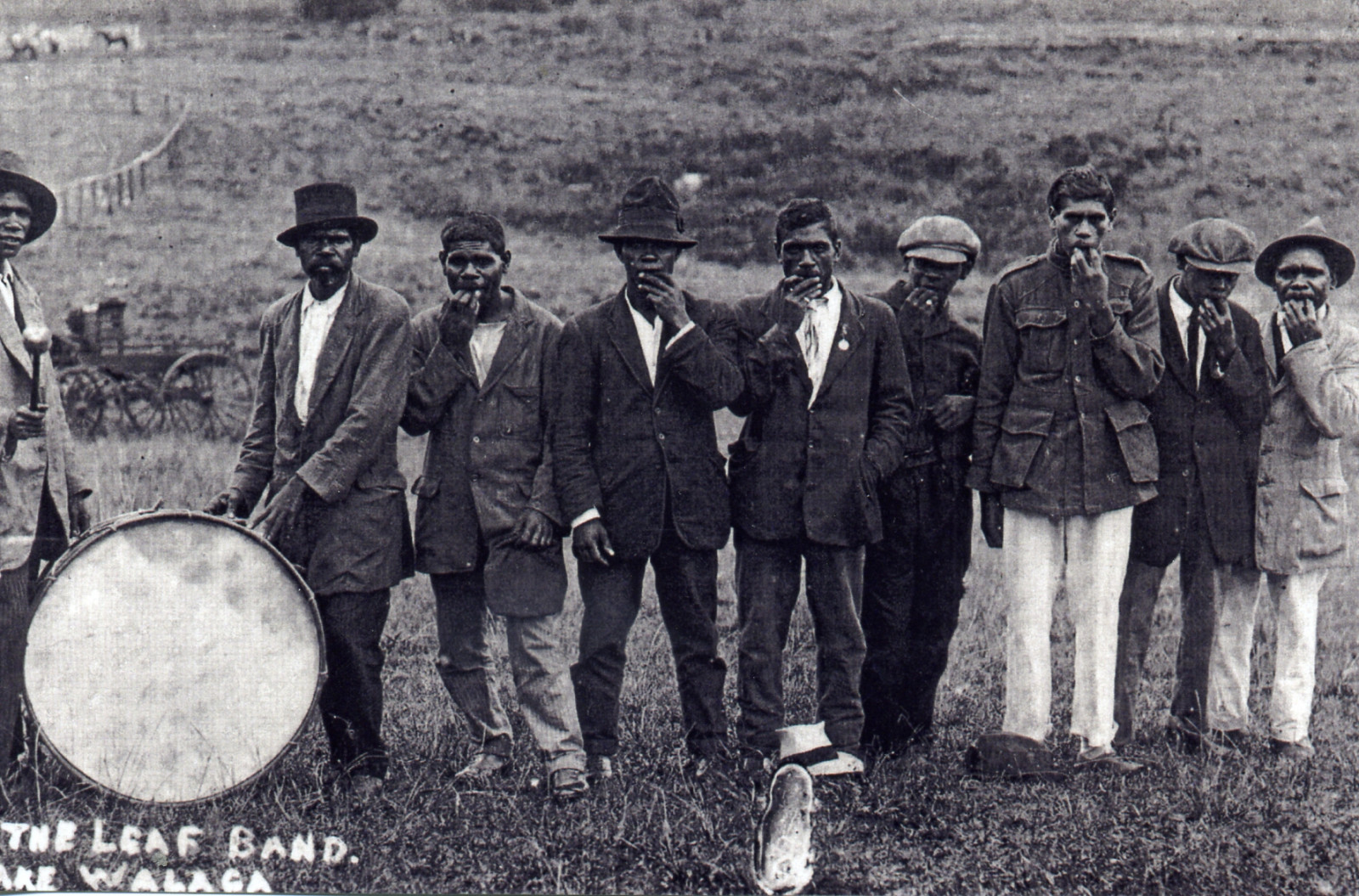
This is a photograph, taken in 1922, of ‘The Leaf Band’ from ‘Lake Walaga’ (sic).
The Wallaga Lake Aboriginal Gum Leaf Band was a celebrated musical group that performed from 1900 to the 1950s, in a period when the music played by gumleaf bands enjoyed considerable curiosity and popularity.
Newspapers and radio in the early twentieth-century regarded gumleaf playing as ‘a rustic signifier of Aboriginal material poverty’, but the music produced by its players actually incorporated and reflected a broad range of sophisticated influences – from Aboriginal clapsticks, elements of corroboree and Koori songs to hymns, folk songs, war songs, country and western songs, jazz, John Paul Sousa marches and minstrel standards. And added to this melange of music were elements of burlesque and clowning.
The first local public display of gumleaf playing may well have been at a corroboree at the Bermagui Athletic Club Ground in 1900 when (as the Cobargo Chronicle newspaper reported) ‘rude instruments, made from reeds and leaves of trees, and a concertina, formed the orchestra, and an old darkie acted as conductor, keeping the time by beating a possum rug’.
Early reviews of performances were glowing: The Daily Telegraph of 1st January 1902, when reporting on a ‘sports day’ at Wallaga Lake recreation reserve, commented ‘A great feature was the capital playing by the aborigines by means of gum leaves’ ; The Bega Standard on 10th February 1903 writing ‘The Wallaga aboriginals gave a leaf concert in the Lyceum Hall, Quaama, on Saturday night last. The hall was full, and an agreeable surprise was in store for the audience. The leaf music beat anything of the kind the writer ever heard before by long points. The leaves, violin and concertina harmonized so well that it must be heard before one can believe that it is such splendid music. The time and music were almost perfect. The antics of some of the performers caused roars of laughter. Mumbula (presumably this was Percy Mumbulla, 4th from the left in the photograph) brought down the house with his performance of the corroboree’; and the Bega Budget in a feature on Tilba Tilba on 19th January 1909 observed ‘The blacks have a splendid Leaf Band, and render the most difficult airs with a precision and tone that would do credit to a well-trained military band. The visitor would do well to hear the band perform’.
Perhaps unsurprisingly, the Wallaga Lake Leaf Band was invited to perform on many occasions. These included gigs at concerts, at dances, in circuses and cinemas, with bush bands and dance bands, at stage shows and fairs, at schools and at weddings, at gymkhanas and picnics. A 1930s Leaf Band Vaudeville Show in Ulladulla evidently ‘whipped the audience up to excitement pitch before closing with ‘The Battlefields of Europe.’ Since the chorus line ‘Tell mother not to wait for me, for I’m not coming home’ would always make the audience crumble, the cast made it a practice to pass out paper handkerchiefs to the audience as they entered the hall’.
Probably the Band’s most amazing ‘tour’, though, occurred in the late 1920s ‘when the band members walked from the Murrah (south of Bermagui) to Melbourne to perform at a large ball. They slept under bushes, cooked fish on hot coals and performed in halls along the way. Following their residency at the Palais Royal in Melbourne (probably at the Royal Exhibition Building in Carlton), their engagements included a brass band meet at Bendigo, a corroboree in Dandenong and a Labour Day March up Swanston St. They then walked on to Cummeragunja in NSW (an Aboriginal Station near Barmah on the Murray River) on their round trip back to Wallaga Lake.’
At the opening of the Sydney Harbour Bridge in 1932, the four participating Wallaga Lake Gum Leaf Band ‘warriors’ were described as ‘… a symphony orchestra among gumleaf bands’. The Band then appeared in two 1930s movies - at a time when gum leaf bands were at their most popular - with the Young Chronicle (April 13th 1934) then suggesting ‘Writers are advocating that an aboriginal gum-leaf band be sent on a world-wide tour, and the Wollaga Lake aboriginal band of about a dozen players is cited as being typical of what music such a body can produce. For one thing the tour "would dispel," they say, "the common belief that the Australian native is one of the lowest types to the world."’
Several factors led to the mid-twentieth-century demise of gum leaf bands: Aboriginal Stations were being closed, there was a drift by Aboriginals to the cities, and rock & roll led to guitars becoming a much more appealing musical instrument to young Indigenous people than were gum leaves. For a while, a few gum leaf trios, duos, and lone minstrels survived – but eventually their novelty appeal completely dissipated and gum leaf bands virtually disappeared.
Members of The Wallaga Lake Aboriginal Gum Leaf Band in 1922 were Percy Davis (Square Block), Ned (Ted) Hoskins (Pudding), Ernie Hoskins (Friday), Percy Mumbulla (Bing), Harold Picalla (Dessy), Willy Thomas (Whaler Billy), Andy Bond (Digger) who had served in World War I depicted in the photograph wearing his former AIF jacket, Albert Thomas (Bookal) and Cronjy Parsons (Sonnoboy)