South Coast NSW History Story
The (detested) Charcoal-Burning Producer Gas Units
EVERY PICTURE TELLS A STORY
The (detested) Charcoal-Burning Producer Gas Units
When World War II started Australia had enough petrol reserves for three months and very limited storage capacity.
Though fuel rationing wasn’t immediately imposed, the government urged citizens to conserve petrol.
However, by October 1940, fuel rationing became a necessity. Over a million civilians applied for petrol ration tickets.
The fall of Singapore in early 1942 only worsened fuel shortages. The crisis led to an unexpected saviour – charcoal.
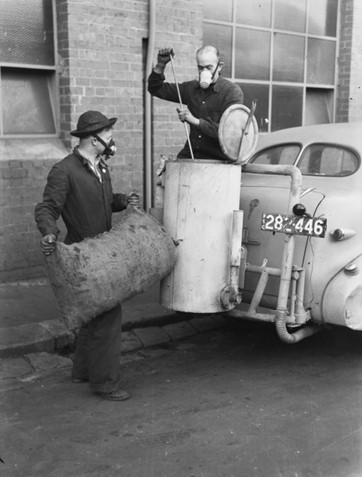
Charcoal-fuelled gas producing units soon became essential vehicle accessories. These burned charcoal in drums, about the size of a washing machine, that was attached to a rear bumper or a platform, or was pulled in a separate trailer. Producer gas units, as they were called, were cheap. Charcoal was relatively simple to produce, but these gas units were universally hated. They were dirty, smelly, prone to catching fire, and they underpowered the vehicle to which they were attached.
It took at least 15 minutes to get a vehicle started, and this had to be repeated if the vehicle stopped for more than half an hour. But, at least, travel remained possible without utilising very much of Australia’s scarce petrol supplies.
To convince motorists that these producer gas units were viable, the Commonwealth Government announced it would instal them on 20 per cent of their vehicles.
In April 1942, the Premier of NSW, William McKell, noted that ‘The seriousness of our present situation makes it imperative that available petrol stocks, very difficult of replacement, shall, as far as possible, be reserved for the use of the military authorities and the maintenance of essential services. All other utilitarian transport should without delay be equipped with producer gas units. This calls for an ever-increasing supply of charcoal. Sufficient supplies to-day will prove altogether inadequate to meet the demands of tomorrow.’
The Member for the South Coast, Rupert Beale, however, has previously (in July 1941) suggested the South Coast could solve the supply challenge: ‘The demand for charcoal is increasing daily and before long huge quantities will be wanted. The timber used is iron bark, gum, box and blackbutt, and this is obtainable in abundance on the South Coast. I put it to the timber millers and others to add to their production, and create employment and industry on the Coast, to help keep their towns going by producing charcoal. The Minister for Transport Sydney and the Forestry Department, Sydney, will supply all, the information about kilns and charcoal burners, registration, and quality, etc., and I think they will send an officer to show people how to make it. Messrs Mitchell Bros of Narooma have very kindly invited anyone to inspect the simple burner they have installed at their mill at Narooma. Charcoal depots will be established all along the Coast shortly, and ways and means will be found to send all that the South Coast can supply to the cities, so it is left to the enterprise of the people concerned to help themselves to this new avenue of making money, and if good charcoal is made, I think the price obtainable will prove fair and profitable.’
Forestry Commissions became a major producer of charcoal. In Victoria, for example, by mid-1942 there were 221 charcoal kilns operating in State forests and 300 Italian war internees (‘enemy aliens’) were put to work cutting wood, each of whom produced around 24 tons of wood per week.
Local Councils were also strongly encouraged to produce charcoal, both for local consumption and to meet the needs of those in the cities, and to become local distributors of the product. McKell again: ‘I would urge upon alderman and councillors that they can assist their constituents and the nation by directing their energies to the production of this essential substitute motor fuel, particularly as the enterprise will prove profitable from the outset and impose no restriction on the carrying out of routine tasks.’ In March 1942 Mumbulla Shire (the shire immediately to the north of Bega) was producing 400 tons of charcoal per week and had plans to increase this to 3,500 tons per week.
But, there was good charcoal and there was bad charcoal. ‘For months, the N.RM.A. inspector has been travelling the State using a producer gas unit. He had his first serious trouble with charcoal when, after 10,000 miles on producer gas, he used charcoal bought at the Braemar kilns at Casino. The inspector reported that at least a third of the charcoal was dust, and that he had almost a week of trouble caused by choked filters and clinker in the generator. This charcoal cost 4/10 a bag…The inspector complained of both the quality and the price of charcoal on sale at Bombala. The price was 6/- a 401b. bag, the bag itself costing extra; and the quality was so poor that a bag lasted only 35 miles. At Cooma, where the price was 4/-, there was only 25 miles of running in a bag of charcoal. The extraordinary range of prices is further indicated by the following figures, cited by the N.R.M.A. inspector: Queanbeyan, 5s 6d per 501b. bag; Narooma, 4s per 601b. bag; Ulladulla, 3s 6d per 601b. bag.’
The demand for charcoal to fuel gas producers became so great during World War II that it led to a shortage of firewood…a bag of charcoal was the prize for the runner-up in a golf tournament in Narooma in August 1942…and from April 1942 Pioneer Service Cars stopped their practice of picking up or delivering passengers to their homes.
Photograph: Charcoal producer gas unit mounted on the back of a car. Image: AWM 027267