South Coast NSW History Story
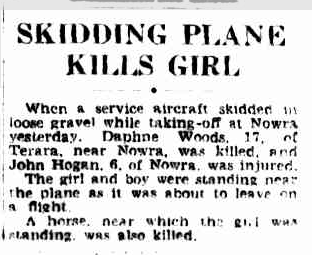
SKIDDING PLANE KILLS GIRL
This is a report that was included the very bottom of page 9 of the Sydney Morning Herald on Wednesday 11th March 1942. It provides few details about the incident – perhaps because the Herald’s Editor thought it would be of little interest but, more likely, because a more detailed report would have attracted the attention and ire of the wartime censor.
There is, however, a very interesting, very little-known back story to this brief report.
In March 1942 there was a very real fear that Australia would be invaded by the Japanese. Less than a month earlier, Singapore had fallen to the Japanese, Darwin had been bombed, the Battle of Java and the Battle of Port Moresby had begun. And two of Australia’s few battleships had recently been sunk – the HMAS Sydney by the German raider Kormoran with the loss of 645 lives on 19th November 1941 and the HMAS Perth which was sunk by the Japanese Navy on 1st March 1942 with the loss of 343 lives and the capture of another 324 of its crew.
But, Australia was very ill-prepared to repel any invasion. Most of those then serving in the RAAF had been sent to Britain where many participated in the Battle of Britain and, from March 1942 to August 1942, the main responsibility for the air defence of Darwin had been handed to the US Army Airforce’s 49th Pursuit Group which had only arrived in Australia in February 1942.
Many of the 49th Pursuit Group’s pilots were inexperienced. For example, of the 102 pilots in its three fighter squadrons, only seven had previously flown a P40E Kittyhawk, the aircraft they were to commonly use in Australia.
For some reason, on 9th March 1942, a number of these aircraft (most likely 6 of them) made an emergency landing in a field near Terara, just east of Nowra. One had its left wing, landing gear and propeller damaged when landing and, on 26th March 1942, it was transported on the back of a truck to Bankstown. It was later recorded that oil had covered the Kittyhawk’s windscreen which had reduced the pilot’s visibility.
Evidently, upon landing, the pilots were confronted by two local farmers armed with a shotgun, believing them to be Japanese!
It is unclear why these aircraft were in the area at the time and why they were landed in the field at Terara. It is possible they were running low on fuel and, with few navigational aids and rudimentary maps, mistook the field for the landing strip at RAAF Nowra (now HMAS Albatross) which, being quite undeveloped at that time, would have been very difficult to spot from the air.
At noon the following day (10th March), the aircraft that had successfully landed were to take off.
An 18-year-old girl, Daphne May Woods, had been at home recovering from the mumps and was caring for a 6-year-old neighbour, John Oxley Hogan. They decided to ride a horse to the nearby field to watch the planes take to the air and were standing behind two fences about 50 yards from the take-off area.
The fifth plane attempting to take off, however, veered sharply from its take-off run and then crashed through the two fences onto the unfortunate onlookers. Daphne, who was evidently struck on the back of head by a wing of the plane, was killed instantly. John was dragged some distance by a part of the aircraft’s undercarriage and suffered extensive head injuries. He remained in hospital for quite some time. Their horse was also killed in the accident.
Daphne’s death had a profound impact on the local community. She was an active member of the local Light Horse Women’s Auxiliary, travelled to Nowra twice a week to help with the manufacture of camouflage nets, and corresponded with local men who were away serving in the armed forces. It was recorded that her ‘funeral was the largest ever witnessed in this district, despite petrol rationing, and never has the writer, in a long experience, seen so many floral tributes piled over the grave as were piled over hers’.
Strangely, the official history of the 49th Pursuit Group in World War II includes no mention of the landings at Terara or of Daphne’s death. But aircraft crashes were so numerous at the time that pilots were jokingly told that to fly to Darwin they simply needed to follow the trail of crashed Kittyhawk P40s!
We thank local historian Cris George for bringing this story to our attention, and for providing the information that enabled us to compile this piece.