South Coast NSW History Story
MERIMBULA
‘Merimbula’ is derived from a Yuin Aboriginal word meaning ‘two lakes’ – an appropriate description of the local Merimbula Lake and Back Lake landscape.
Merimbula was originally a private village that was established in 1855 by the Twofold Bay Pastoral Association which has been formed in 1852 by Robert Lucas-Tooth (see Kameruka Estate) and which acquired 400,000 acres on the South Coast and Monaro. The Association immediately built a wharf adjacent to the town, so that livestock and wool could be shipped from the Monaro and the local area.
Allotments of land went on sale in 1860.
In 1867, Matthew Munn, a Scottish immigrant, turned an existing flour mill into a business producing cornflour which he called ‘Munn’s Maizena’. This provided the town with its first large-scale industry. Maizena became acclaimed worldwide and Munn’s factory became the major employer in the areas until about 1917.
In 1922 his cornflour works were converted into a bacon processing factory.
Meanwhile oyster growing, timber-getting and agriculture also developed in the area, providing the area with a broader economic base.
From the late 1850s, Merimbula became an important, regular port of call for vessels operated from Sydney by the Illawarra and South Coast Steam Navigation Company. These services continued until 1952.
In 1902 the Government built a deep-water wharf just outside the lake so that larger steamships could service the area, and because the existing jetties around the lake were proving incapable of handling the volume of shipments from and to the town.
By the 1950s, with improvements to the Princes Highway north from Melbourne and south from Sydney, and the opening of Merimbula Airport in 1959, Merimbula had become a popular holiday resort.
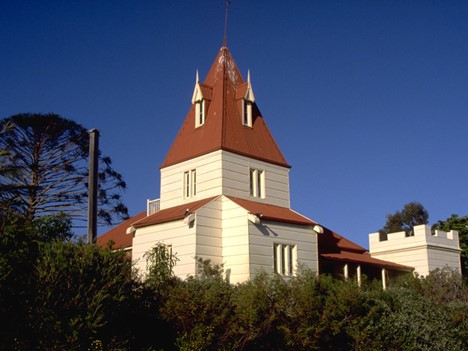
The only buildings in Merimbula that have survived from the early years of development of the town are ‘Courunga’ (now usually referred to as ‘The Tower House’) that was built in 1873 by Matthew Munn as a wedding present for his son Armstrong, and the town’s first public school building which was constructed from locally quarried stone in 1875 (now housing the Merimbula Old School Museum).