South Coast NSW History Story
JAMBEROO
Cedar-cutters were the first Europeans to visit the Jamberoo Valley, arriving as early as 1810. The first pioneer settler was a William Davis who received a land grant in 1821. He was followed shortly thereafter by a John Ritchie and a John Cullen.
Michael Hyam, who had acquitted a property by the late 1830s, laid out the private village of Jamberoo in 1841. The Main South Coast Road (now Jamberoo Road) ran along the northern boundary of his village. At the western end of the town, parcels of land were given to the Protestant Churches; the Presbyterian church and the Methodist Church (now Uniting Church) are still sited on the original lots, the Anglican Church has been moved but the Anglican cemetery still occupies the original site.
Jamberoo (which is an Aboriginal word meaning track) became the first thriving town in the area because it was at the junction of roads from Sydney to Nowra and from the Southern Highlands to the South Coast. Hyam built a hotel (The Harp Inn), stores, blacksmith shop, tannery and boot makers, and a racecourse. (He ultimately sold his property to a Robert Owen in 1846, who divided the estate into 10-40 acres lots.)
In 1838, Woodstock flour and timber mills were built on the bank of the nearby Minnamurra River, creating another village. Woodstock Village later grew to include a brewery and two hotels, piggery, cooperage and bacon factory, and had over 80 residents. The mills, however, experienced a series of financial problems and were ultimately demolished in 1873, leaving no trace of the Woodstock mills or village.
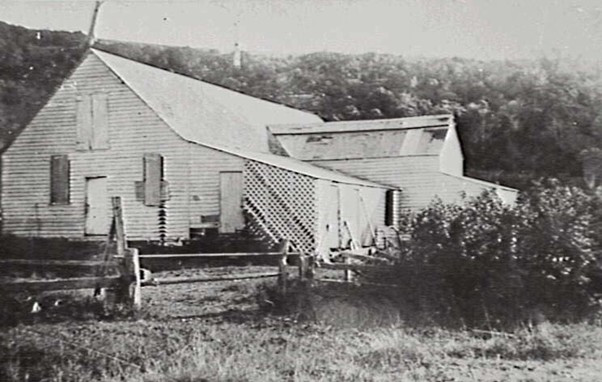
By the late 1800s the Jamberoo Valley had become a major butter producing area, supporting four butter factories. Factory Lane is a reminder of the location of one. In 1884 the Pioneer Butter Factory, was established in the Jamberoo Valley. It is credited with having been the first co-operative butter factory in Australia, the first Australian factory to use a cream separator (cream separators transformed processing in the dairy industry) and the first Australian factory to successfully ship butter to Great Britain.
From the 1860s to the 1890s, the Australian Illawarra Shorthorn cattle breed (a mix of milking Shorthorn, Ayrshire, and Devon cattle that resulted in a hardy dairy breed) was developed around Jamberoo.
Jamberoo village declined once the main road south from Sydney changed when a road bridge was constructed over the Minnamurra River in 1872 (it was replaced with another in 1890) and the railway extension to Kiama in 1888 bypassed the village.
Today, Jamberoo Action Park is a well-known local attraction. It was opened in October 1980 as Jamberoo Recreation Park on a dairy farm that had become unstainable as a dairy. Originally it featured grass skiing (and in 1983 hosted the World Grass Skiing Championships) but later moved its major focus to adventure-based and water-based rides.
Image: The Pioneer Butter Factory, Jamberoo