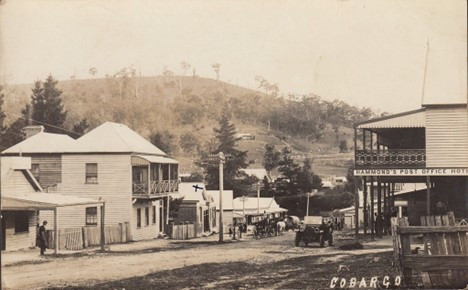
South Coast NSW History Story
COBARGO
The first European who ventured to the Cobargo district was William Duggan Tarlinton who did so in February 1829. He had been guided by three Aboriginal men from near Braidwood along a track that had traditionally been walked by First Nations people.
Tarlinton returned the following year, selected land, erected slab and bark huts and ‘squatted’. He ran cattle on his property – a property that was to gradually increase in size.
When first developed in the late 1860s, Cobargo was known as ‘The Junction’ because it was sited at the junction of Narira and Bredbatoura Creeks.
The town serviced a substantial local farming community at the time, as was demonstrated when 37 children enrolled in the local school when it opened in 1871.
Dairy farming became the area’s main activity and a large butter factory opened near the town in 1901. It continued in production until 1980. Timber getting, sawmilling and wattle bark harvesting were, at times, other significant local industries.
The building of a bridge over Narira Creek in 1882 and improvements to the local main roads in the 1880s and 1890s encouraged the development of the town. A School of Arts was opened in 1887 and Roman Catholic Church was opened in 1898 on land that had been donated by the Tarlinton family. This Church became the centre of a substantial Roman Catholic precinct that also included a presbytery, a school and a convent.
By the 1890s the town supported a newspaper, the 'Cobargo Watch & South Coast Journal' (which in 1898 became the 'Cobargo Chronicle', and was published through to 1944).
The town declined in importance in the early 20th century as transport developed and it became easier for locals to travel to larger centres.
Much of Cobargo’s interesting and historic old streetscape was destroyed by a bushfire on 31st December 2019.