South Coast NSW History Story
BOMBO
Bombo is the gateway to Kiama.
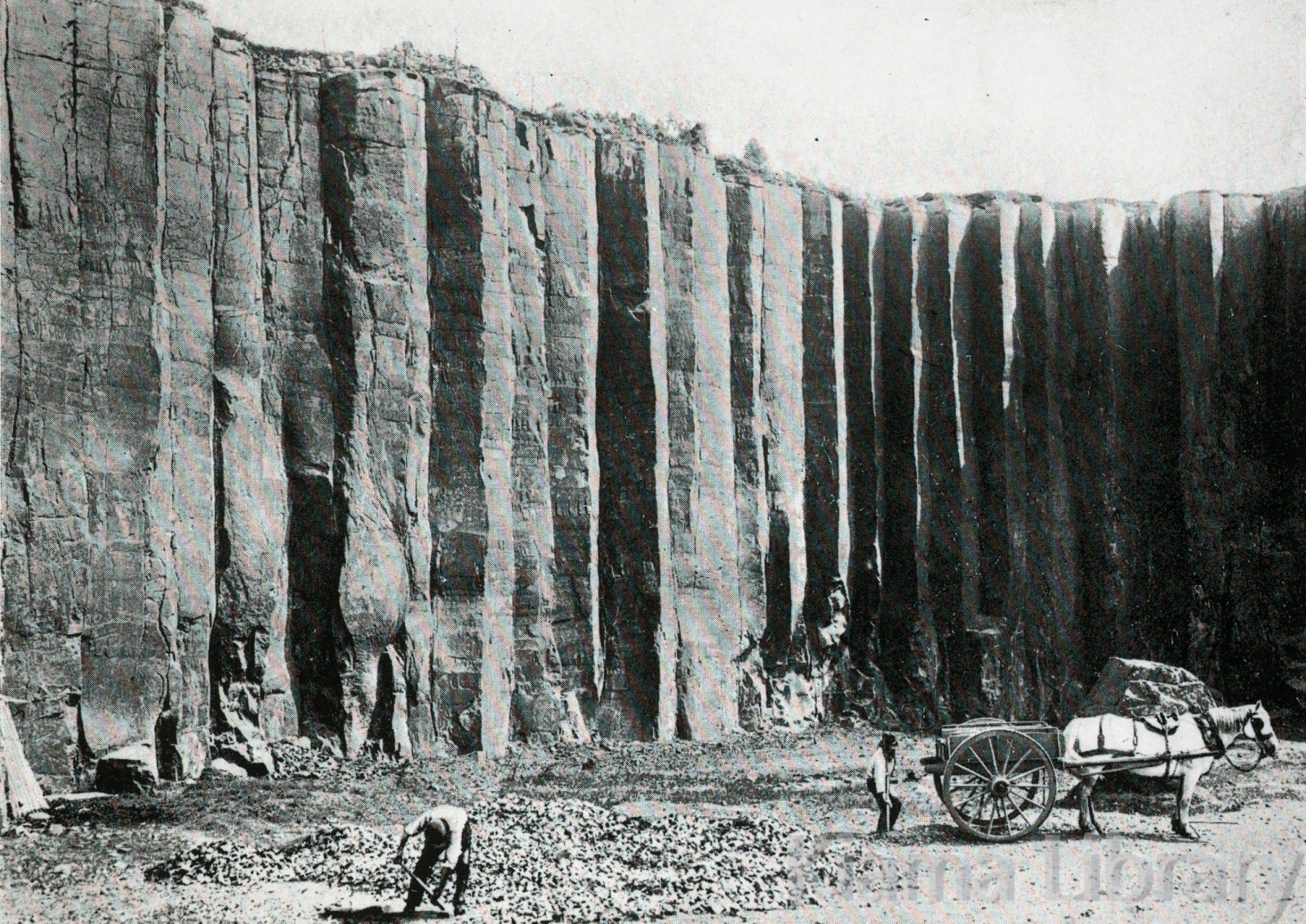
In 1838 a farmer, James Holt, bought 320 hectares of land at Kiama. Columns of basalt rock were discovered on his land in the area that became known as the Bombo Headland Quarry.
Quarrying commenced in the 1880s. Some of the basalt was used in the construction of local buildings (the old Kiama primary school (now part of the Sebel), the Anglican Christ Church, and the Kiama Courthouse are surviving examples) but most was crushed to become blue metal. This was used on the tram and train lines that were then being built across the state. In the early years, 70-80 men were employed in the quarry to ‘hand dress’ the stone ready prior to transport.
By 1887, steam crushing machines and equipment were introduced to crush the stone.
In 1883, a large jetty was built on the northern side of the headland, now known as the Boneyard, to move the mined blue metal to Sydney. The jetty was quite exposed, so was not always a reliable port for the loading of ships. It operated into the 1890s.
The railway from Sydney was extended to Bombo (then known as North Kiama) in 1887, and a side-track was constructed into the Bombo Quarry. In 1890 the Railways Commissioners bought the quarry which they owned until the mid-1920s.
The Bombo Quarry was closed during the Depression years, but re-opened between 1937 and 1941, and again from 1944 to 1954.
The quarry at Bombo was the site of a serious accident on 7th May 1888, when an explosive charge detonated prematurely and a mass of rock fell on men working below. Four were killed and several severely injured.
The local Aboriginal word for thunder was ‘bumbo’, and the area was originally given that name. A local minister of religion, asserting that the name sounded too rude, successfully had the u replaced by an o.
Geologically the quarry area is important because its rocks provide evidence of what is known as the Kiama Magnetic Reversal – a giant flip in the Earth's magnetic field about 260 million years ago.