South Coast NSW History Story
Arthritis and the Whale
Arthritis and the Whale
by Ken Robinson
Doctors say there is no cure for rheumatism - rheumatoid arthritis - but there are medications that can be used if you need relief from rheumatic pain. Some of you may, for example, remember the 1950s and 1960s radio and television commercials and newspaper advertisements for Dr MacKenzie’s Menthoids – for relief of backache, rheumatic and muscular pain, take Menthoids – M-E-N-T-H-O-I-D-S, spoken with a Scottish accent. Dr MacKenzie did not claim to cure you of the problem, but he would at least relieve some symptoms. More sophisticated, modern drug treatments are now available, leading to improvement in symptom control and reduction in progression of the disease.
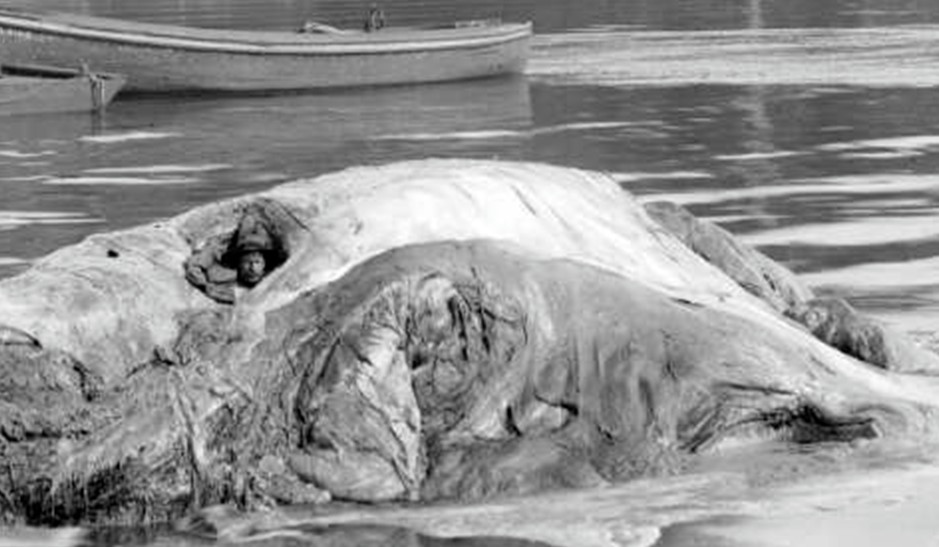
I won’t comment on how effective Dr MacKenzie’s ‘cure’ was,but I can direct you to a famous cure used well before the good doctor got into the business. At the end of the 19th century, South Coasters were blessed with access to a ‘cure’, but only if you had the appropriate materials and were prepared to undertake the inconvenience of it all. This cure was a by-product of the whaling industry, requiring access to whale oil and, preferably, to a dead whale.
The “Whale Cure”, as it was known, became famous worldwide. First reports of the cure appeared in newspapers in the 1890s. The Pall Mall Gazette, for example, published a piece which was reproduced in the New York Times of March 1897. The article described the event of a “gentleman of convivial habits” who launched himself into a whale on the shores of Twofold Bay and emerged two hours later, completely sober and free of the rheumatism from which he had been suffering for many years.
The Newcastle Morning Herald and Miners’ Advocate in December 1895 provided a detailed piece by its correspondent CLIO, who wrote:
_The first I heard of the wonderful whale cure was some two or three years ago, when a tipsy fellow ran into a whale (right inside) and refused to come out for over two hours, his friends being unable to endure the heat and smell to attempt a rescue. When he did come out he found himself perfectly sober and quite free in the limbs. He had previously suffered from rheumatics. The shrewd folk of the bay at once took up the idea, until now it is an established and well-known thing.
The whalers dig out a huge hole in one part of the body, and the patient strips naked (in the case of women a calico gown is used), and lies in the hole, the whalers following their own work on another part of the huge carcase. Two hours is considered a sufficient time to remain in the whale. Indeed, two hours is quite long enough for any man to stay, as the body is very hot, on account of the gases generated in decomposing. No charge is made by the whalers for a dip in the whale. Dr. Eddie, of Bombala, having been to the bay and studied the process, is of opinion that the cure is effected by the heat of the whale acting as a huge poultice over the entire body.
Like many cures for disease there are sometimes unfortunate side-effects. The whale cure for rheumatism was reported in the Sydney Bulletin in 1896 where a candidate for the cure described his experiences. He particularly noted, that once he emerged from the whale:
The effect was wonderful. They rubbed me down, dressed me …and put me in the boat; then we returned to Eden. That evening ….the rheumatism was all gone – not a twinge! They got me a glass of rum to get a good perspiration up, but the rum refused to go below my head; the smell was too strong for it.
After four days I walked up town, and everyone I met shied at me – a leper could not have been avoided more discreetly. Girls that I knew cut me dead; men whom I considered true brothers held their noses and bolted; sometimes a man would gallop past, and, if on a fast horse, would say ‘Good-day!’ and vanish. Of course, being a country fellow and sensitive, I felt this - never dreaming the true cause. For exactly twelve months the rheumatism left me; then it came back again as bad as ever. The smell has never left me: that dead whale haunts me still.
Word of this miraculous cure spread and Eden, on the shores of Twofold Bay, became a haven for patients with the rheumatism. The sufferers gathered at a local hotel which benefited from the many guests seeking a cure. When a whale was caught and available, the patients were rowed to the whaling station and were able to avail themselves of the cure.
The Sydney Sunday Times, July 1902, described an extract from the London Graphic which demonstrated how famous the cure was and its world-wide attraction. The pictures showed:
An Englishman who is afflicted with rheumatism reading an account of the wonderful effects of the whale bath – his departure on crutches for New South Wales – his arrival with his wife at Eden and interview with a strong-smelling individual who conducts the whale bathing – the bestowal of patients in the whale – the return of the Englishman cured and indulging in gymnastics, to the “Big Smoke”.
There was also some perceived benefit in bathing in whale oil, without the need for “full immersion”. A photograph, taken at Eden in the early 1900s, shows the master whaler Charlie Davidson sitting in one of two 'try pots' in the foreground as another whaler, Roy Davidson, pours whale oil over him. Two other whalers, Jack Davidson and Alex ('Allie') Greig, are standing nearby, one of them watching the process.
Despite its popularity around Eden and being famous around the world, the cure fell out of use by the First World War. This was probably due to the smell and the shortage of available whale carcasses, and well before the arrival of Dr MacKenzie’s potions.
Sources: Newspapers from Trove; National Library of Australia; Australian National Maritime Museum; Eden Killer Whale Museum.